
Specifications vs. Drawings: Who Wins When Documents Conflict?
- jaehorbacz
- Aug 17, 2025
- 4 min read

In construction projects, accuracy and clarity are everything. Yet, even with the most careful planning, conflicts between specifications and drawings (or even between different types of drawings) inevitably arise. When they do, the big question often becomes: which document takes precedence—specifications or drawings?
In this blog post, you will learn about the common issue of conflicts between specifications and drawings in construction projects. The post will guide you through:
Understanding Specifications and Drawings: The distinct roles they play and how they are meant to complement each other.
Document Precedence: Insights into whether specifications or drawings take precedence, depending on various contract types and clauses.
Order of Precedence Clause: The importance of this clause in determining document hierarchy and avoiding disputes.
Typical Scenarios: Situations where specifications or drawings might take precedence.
Best Practices: Practical tips for preventing and resolving document conflicts to ensure project success.
By the end of this post, you'll have a clearer understanding of how to navigate and resolve conflicts between specifications and drawings, ensuring clarity and compliance in your construction projects. As with most aspects of construction law, the answer isn’t absolute. Let’s break it down.
Specifications and Drawings: Different Roles, Shared Responsibility
Specifications: Written documents that define materials, performance criteria, quality standards, and installation methods. They establish how the work must be performed and are traditionally regarded as legal, enforceable documents.
Drawings: Graphic representations of the design intent that show what and where things are built—plans, elevations, sections, and details.
Together, these documents form the backbone of the contract. They are meant to be complementary, not competing, but gaps and contradictions do occur.
Do Specifications Automatically Override Drawings?
A common misconception in the industry is that specifications always “win” during document conflicts. In reality:
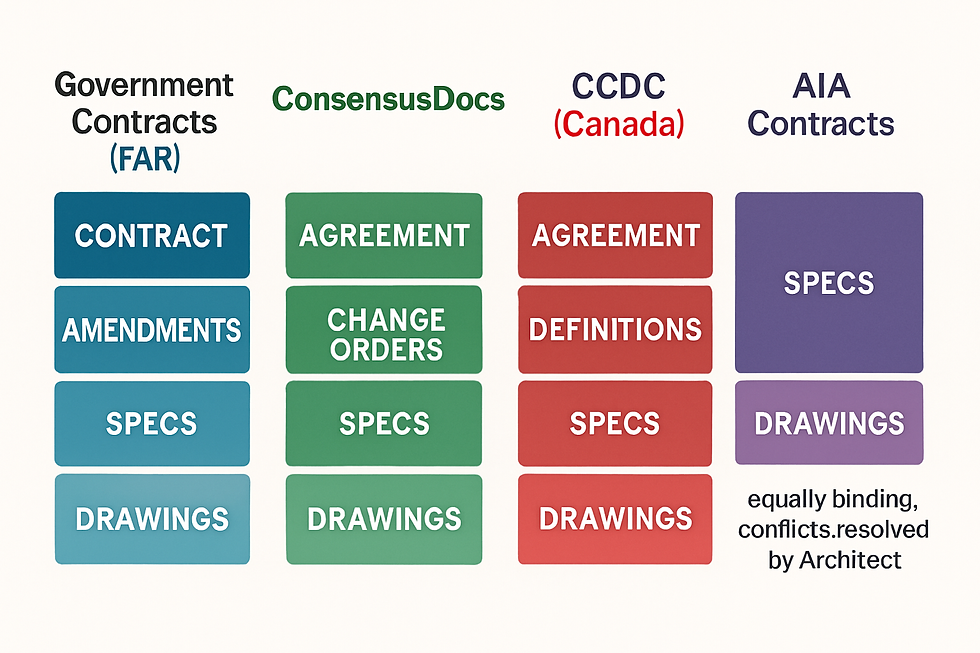
Government Contracts (FAR): Strict hierarchies are often spelled out.
ConsensusDocs, CCDC (Canada), FIDIC, and certain government contracts often establish a clearer hierarchy—frequently giving specifications priority, providing explicit ranking of contracts, specs, and drawings.
AIA Documents: Rarely establish hierarchy, preferring the architect to interpret. Standard AIA contracts (such as AIA A201) treat specifications and drawings as equally binding, requiring the architect to interpret and resolve conflicts.
Custom Contracts: Owners may insert a precedence list (Agreement → Amendments → Specs → Details → General Drawings), or they may reverse the standard approach, expressly giving drawings control. Without a clause, disputes get messier, forcing courts to fall back on broader legal principles (like “specific trumps general” or interpreting ambiguities against the drafter).
👉 There is no universal rule. Hierarchy depends entirely on what’s written in your project’s Order of Precedence Clause.
When Specifications Typically Override
Specifications usually take precedence when:
The contract explicitly says so. This is common in government work.
Special provisions or technical requirements supersede generic drawings.
Following a drawing would void a warranty, reduce quality, or conflict with code.
Courts or arbitrators determine specifications provide the more specific and enforceable direction.
When Drawings or Details Take Precedence
While less common, there are situations where drawings rule the day:
The contract expressly states that drawings override specs (rare but possible).
Large-scale detail drawings conflict with general plan drawings. In this case, the detail drawing almost always controls because it is more specific.
Field conditions or approved change orders generate updates on drawings that alter previously issued specifications.
👉 Important distinction: Details only override when there is a conflict, not an omission. If the detail is silent, project teams must defer to the specifications or general drawings.
Why the Order of Precedence Clause Matters
Most conflicts trace back to one simple issue: whether the Order of Precedence clause was carefully reviewed during contract formation.
Risks of Leaving Hierarchy Undefined
Failing to establish precedence creates:
Ambiguity in contractor obligations.
Greater dispute risk, often leading to RFIs, claims, or litigation.
Delays and financial exposure if work must stop until direction is clarified.
Reliance on courts to determine intent—an expensive and uncertain process.
Best Practices for Preventing Document Conflicts
Always check the Order of Precedence Clause before assuming which document governs.
Proactively coordinate Specifications and Drawings during design.
Clarify conflicts early with RFIs, rather than risk liability.
Document resolutions through addenda, supplemental instructions, or change orders.
Maintain strong Contract Administration Practices—regular reviews, audits, and communication channels.
The truth is: specifications don’t always override drawings, and drawings don’t always override specifications. Instead, the contract tells you which document leads—or requires that the architect or engineer resolve the conflict.
The safest approach?
Don’t assume specs always win.
Don’t ignore details on drawings.
Do check your contract language and issue RFIs when in doubt.
Clarity here isn’t just about paperwork—it’s about protecting quality, safety, compliance, and ultimately, the success of your project.
Who Wins in Document Conflicts? (Specs vs. Drawings)
Start: A Conflict Appears Between Specs and Drawings
⬇️
Step 1: Does the Contract Have an Order of Precedence Clause?
Yes → Follow hierarchy listed (often Specs > Drawings, but check!).
No → Proceed to Step 2.
⬇️
Step 2: Which is More Specific?
Large-scale/detail drawings override general drawings.
Detailed specs override vague specs or generalized drawings.
⬇️
Step 3: Does Following One Path Risk Safety, Quality, or Warranty?
If Yes → Specs/requirements for compliance usually govern.
If No clear answer → Architect/Engineer interprets and provides direction.
⬇️
End: Always Document Resolution!(via RFI, Addendum, or Change Order)
✅ The Key : Don’t assume specs always win. Don’t ignore details.
Check your contract → Identify conflicts → Document clarification.
If you found this guide helpful and want to ensure your construction projects run smoothly without document conflicts, consider reaching out to Architex Resources LLC. Our team of experts provide personalized consulting and comprehensive specification writing services tailored to your project's unique needs. Contact us today to learn more about how we can help you achieve clarity and compliance in your construction processes. Sendf us an email or visit our give us a call (732) 606-7633 to get started. Let's build a better future together.


Comments